


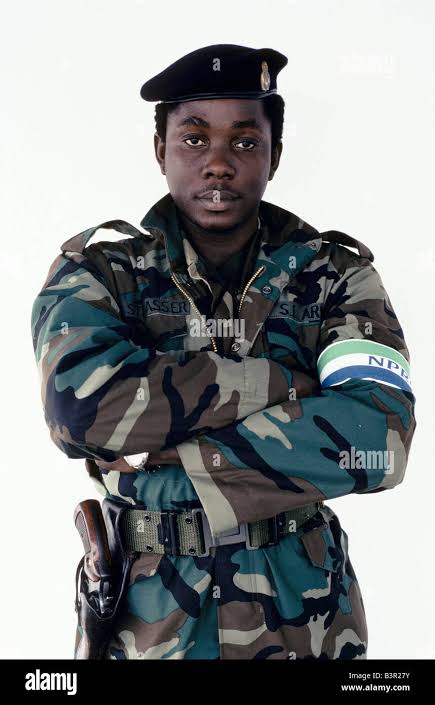
In April 1992, Sierra Leone was coming apart. In the eastern and southern rainforests, government troops had spent a year fighting the Revolutionary United Front (RUF), a rebel movement that had crossed in from Liberia in 1991. The war was fought by an army that had been starved of everything. Young officers on the front line held their positions with jammed rifles and worn-out boots. Rations and salaries arrived late, or never. Meanwhile, the officers believed, the men in Freetown were living well.

For Captain Valentine Strasser, then 25, the neglect became physical when he was wounded in the fighting. He had gone months without pay. He and a small group of fellow junior officers decided to stop appealing and start confronting. They abandoned their positions and drove to the capital to put their grievances to President Joseph Saidu Momoh at State House.
A Throne Left Empty
The government they were driving toward was far more brittle than anyone had assumed. Momoh had inherited power from Siaka Stevens, whose one-party All People’s Congress had hollowed out the state over nearly two decades. When word reached State House that armed, exhausted soldiers had arrived in Freetown, Momoh did not wait to hear what they wanted. He fled by helicopter to neighbouring Guinea.
The young officers found the seat of power vacant, and they took it. They formed the National Provisional Ruling Council (NPRC) and made Strasser its chairman. Overnight, a captain barely into his career became the world’s youngest head of state. He wore camouflage fatigues and dark sunglasses, a look that projected a confidence he could not yet have earned, and the world took notice.
The Four-Year Storm
Seizing a capital proved far easier than running a country at war. The NPRC promised discipline, an end to corruption and a quick victory over the RUF. At first it won real goodwill, particularly among young people exhausted by the old order. Strasser’s government soon showed a harder side, though. Critics accused it of heavy-handedness, and in December 1992 it executed a group of soldiers accused of plotting a counter-coup, a move that drew international condemnation.
The war itself did not yield. The rebels kept up their campaign and rural communities bore the brunt. By 1995 the junta was struggling badly enough that it brought in Executive Outcomes, a South African private military company, to help turn the tide. The contractors helped push the RUF back from the approaches to Freetown, but the government’s dependence on mercenaries said a good deal about the state of its own army.
Pressure to hand power back to civilians was also mounting, from donors, from neighbours and from Sierra Leoneans themselves. A transition to elections was announced, but trust inside the junta was fraying.
The Palace Coup
In January 1996, with elections only weeks away, Strasser’s own deputy, Brigadier General Julius Maada Bio, moved against him. The coup was swift and bloodless. Strasser was arrested, put on a helicopter and flown out of the country, the same kind of exit he had once forced on Momoh. Bio took over briefly and then handed power to the winner of the elections, Ahmad Tejan Kabbah, as scheduled.
The Long Road Home
Strasser’s fall was steep. He travelled to England to study law at the University of Warwick, but the funding behind his studies dried up and he left without the stable footing he needed. His attempts to settle abroad failed, and he eventually returned to Sierra Leone with almost nothing.
For more than two decades, the man who had once commanded a nation lived in obscurity. He stayed with relatives in Allen Town, a modest, crowded suburb of Freetown, and survived on very little. The sunglasses and fatigues were long gone, replaced by the ordinary routines of someone reduced to hardship.
Twilight Years
In early 2019, a severe vascular condition threatened Strasser’s life. In a twist few could have scripted, the government that stepped in was led by President Julius Maada Bio, the very deputy who had overthrown him in 1996 and who had since returned to the presidency through the ballot box. The state covered his medical costs and arranged for him to be flown to Ghana for surgery, where his left leg was amputated.
After his recovery, Strasser returned to Freetown in July 2021. The government gave him a house and a monthly pension. He now lives quietly, far from politics, and his brief, chaotic reign remains one of the strangest chapters in modern African history.