


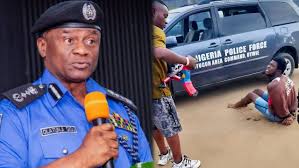
A policeman killed Mene Ogidi on camera. The only question is whether Nigeria will pretend, as it has before, that this time things will be different.

By Nnamdi Prince
I have watched the video. I imagine by now you have too. A young man, twenty-eight years old, a singer who had the rest of his life ahead of him, is on the ground. He is restrained. He is not running. He is not fighting. He is pleading. And then ASP Nuhu Usman of the Nigeria Police Force raises his weapon and fires it into Mene Ogidi at close range, on the premises of a motor park near the Warri–Sapele Expressway in Effurun, Delta State, on April 26, 2026. The video ends. Mene Ogidi does not get up.
The Inspector-General of Police, Olatunji Rilwan Disu, moved with remarkable speed. ASP Usman was dismissed. His team was dismissed. They were transferred to Abuja for prosecution. The police authority issued statements of outrage. The language was correct. The gestures were appropriate.
Do not let the speed fool you.
The Nigerian police do not move this fast because they have discovered a conscience. They move this fast because they remember where the last viral video of a policeman shooting a young man in Delta State led: to #EndSARS, to the protests of October 2020, to Lekki, to a national uprising that shook the foundations of the security apparatus and forced the government into a series of promises it has spent every subsequent year quietly abandoning. The speed of the IGP’s response is not a measure of justice. It is a measure of institutional fear.
Let us be specific about what we are measuring.
The #EndSARS panels were constituted across Nigeria’s states in late 2020 and 2021 at the insistence of a traumatised public that wanted accountability and structural reform. Those panels sat. They heard testimony. They documented cases. They named officers. They made recommendations: dismissals, prosecutions, compensation, reform. The reports were submitted to state governments and the police hierarchy.
Not one of the police officers named and recommended for disciplinary action by those panels has been prosecuted. Not one. In a number of documented cases, officers identified and indicted by the panels have since received promotions within the force. The institution did not reform itself. It waited for the noise to die down and then resumed its habits.
The record exists. It has names.
In Anambra State, a whistleblower came forward in 2023 with detailed allegations against three senior police officers; Patrick Agbazue, Harrison Akama, and Nkiru Nwode, linking them to a pattern of torture, extrajudicial killings, extortion, and, in perhaps the most grotesque allegation to emerge from that era, organ harvesting. The whistleblower did not disappear into silence. He disappeared into a prison cell. As of this writing, he has been languishing in detention since 2023. The officers he named have not been prosecuted. Several have been promoted.
In Owerri, Imo State, the Coalition Against Police Impunity in Nigeria and Amnesty International produced documented reports on the Tiger Base police unit , naming victims, naming perpetrators, recording cases of torture, extrajudicial execution, and extortion. The reports identified officers, among them Oladimeji Odeyeyiwa and the officer Inspector Chikadibia Okebata, widely known by the name that is itself an admission: ‘Kill and Bury.’ Those reports sit in archives. The officers named are not in dock. Some have advanced in rank.
Then there is ASP Silvester Dumbiri
ASP Dumbiri was attached to the Nsukka Area Command in Enugu State. The Enugu State SARS panel, convened in 2020 as part of the #EndSARS accountability process, indicted him. He was neither queried nor disciplined. He remained stationed in Nsukka, where, by numerous accounts, he had spent more than a decade building a reputation and, allegedly, a fortune on the suffering of people who had no recourse. Then in February 2025, Dumbiri’s name appeared again, this time connected to the death of a patent medicine dealer named Ugwu, who died in Nsukka police station after an illegal arrest in Obollo Afor. The police authority’s response was swift. They transferred Dumbiri away from Nsukka. Not to prosecution. To a different posting. The man who survived one indictment was rewarded with mobility. The dead man received nothing.
This is the institution that has, with impressive velocity, dismissed ASP Nuhu Usman.
Mene Ogidi reportedly told the officers who arrested him at the motor park that the firearm they claimed to have found on him was planted. He said he was being framed. He offered to cooperate. He begged. The video captures his voice. Whether he was telling the truth about the firearm is now, in the most awful sense, a moot point, because even if the firearm was legitimate evidence of a crime, the sentence for illegal firearm possession in Nigeria is not execution by a standing officer at close range while the suspect is restrained on the ground. Nigeria has courts. Nigeria has judges. Nigeria has a criminal justice system that is slow and broken and corrupt and overwhelmed, but which exists precisely because the alternative, armed officers deciding guilt and administering death in motor parks, is the thing we call barbarism.
Force Order 237 governs the use of firearms by Nigerian police officers. ASP Usman violated it. His dismissal is appropriate. But dismissal is not prosecution. Transfer to Abuja for prosecution is not prosecution. We have watched men transferred, reassigned, and eventually quietly reinstated or retired with benefits. We have watched panels submit reports that were filed and forgotten. We have watched the families of the dead make television appearances and then return to their grief with nothing.
What accountability looks like ; real accountability, not performed accountability, is a courtroom. It is charges read aloud in public. It is evidence examined. It is judgment pronounced. It is consequence endured. It is the message sent, through one case pursued to its conclusion, that the next ASP Usman will pause before he pulls that trigger , not because he fears a transfer, but because he knows that the law applies to him as it applies to the man on the ground.
The rights groups who have condemned the Effurun killing are right to do so. They are right to demand reform. But reform without prosecution is a brochure. The Nigerian police does not need another commission of inquiry, another white paper, another series of workshops on human rights-compliant policing funded by international partners. It needs to watch one of its own go to prison for doing what ASP Usman did on April 26, 2026.
There are those who will argue that the system is complex, that prosecuting police officers is politically difficult, that the force will close ranks, that witnesses will be intimidated, that evidence will be mishandled. All of this is true. All of this has happened before. None of it constitutes a reason not to try. It constitutes a description of exactly the conditions under which the attempt must be made anyway, because the alternative is the permanent message that a man with a badge in Nigeria can shoot a restrained human being on camera and escape with a transfer.
Mene Ogidi was twenty-eight years old. He made music. He had a name and a face and people who loved him, and he spent his last moments on this earth on a motor park ground, begging for his life from a man who was supposed to represent the state’s protection of its citizens. The video exists. The officer has been identified. The legal framework for prosecution exists. The only thing that may not exist is the will to see it through.
We have been here before. After October 2020, Nigeria promised itself it had changed. The panels met. The reports came. The officers named were promoted. And five years later, in the same state where #EndSARS was born, another young man is dead on the ground and another viral video is travelling through our phones, and we are, once again, watching to see what the country will do.
A dismissal is not justice. A transfer is not justice. A press release from the IGP is not justice.
Justice is what happens in court, to a man who shot a restrained human being, conducted to its conclusion, whatever the political inconvenience.
That answer will tell us who we are.