


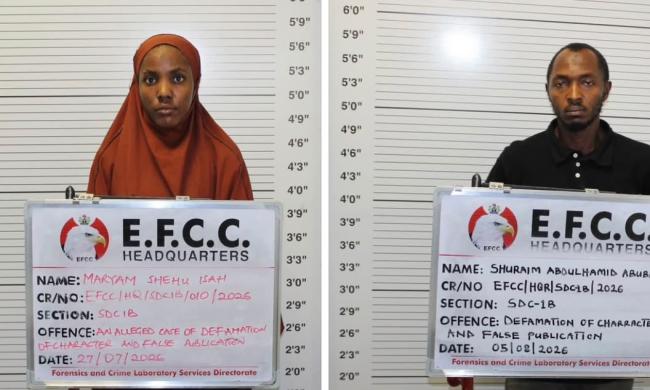
The Economic and Financial Crimes Commission (EFCC) has ordered the withdrawal of cybercrime charges against two Nigerians, Maryam Isah Shehu and Abubakar Shuraim Abdulhamad, days after their arraignment before a Federal High Court in Abuja triggered widespread public criticism.

EFCC Executive Chairman Ola Olukoyede directed that the charges be dropped after what the commission described as “the passionate pleas and apologies of Shehu’s father” and appeals from Nigerians for leniency. In a statement, the EFCC said Olukoyede had “compassionately ordered” the withdrawal, while warning that the commission “would no longer tolerate any wilful attack on its image in any form, medium or platform.” Olukoyede also assured Nigerians that the EFCC would continue to operate within its statutory mandate.
Shehu and Abdulhamad were arraigned separately on Thursday, August 20, before Justice Joyce Abdulmalik on charges bordering on cybercrime, under Section 24(2)(c) of the Cybercrimes (Prohibition, Prevention, Etc.) Act, 2015, as amended in 2024. Both pleaded not guilty.
Shehu, who runs the Instagram account @maryamshehu, was accused of publishing allegations that EFCC officials assaulted a man named Ahmed Uthman on the instructions of a zonal director who allegedly received ₦20 million from one Usman Iya Abbas. Abdulhamad, who posts as @shuraimi on X, was accused of fabricating an image designed to resemble an official EFCC arrest placard.
Following their arraignment, Justice Abdulmalik ordered Shehu remanded at Suleja Correctional Centre in Niger State and Abdulhamad remanded at Kuje Correctional Centre in the Federal Capital Territory. The court had adjourned the matter to August 31 for bail applications and the start of trial.
The reversal came after civic technology group MonITNG publicly questioned the legal basis for the prosecution. The organisation argued that defending the EFCC’s reputation through criminal charges falls outside the commission’s statutory mandate, which centres on investigating and prosecuting economic and financial crimes. While acknowledging that fabricating documents or spreading false information could constitute offences under other laws, MonITNG said reputational disputes are traditionally the domain of civil defamation suits, not criminal prosecution by the agency that considers itself wronged.
The group also warned of a broader chilling effect, saying the case risked deterring journalists, activists, and social media users from scrutinising government institutions. It had directly challenged the EFCC to clarify what specific offence was being prosecuted and how safeguarding the commission’s image fell within its legal mandate.
With the charges now withdrawn, the case against Shehu and Abdulhamad will not proceed on the basis originally filed before Justice Abdulmalik, though formal steps are still required to give full effect to the withdrawal.