


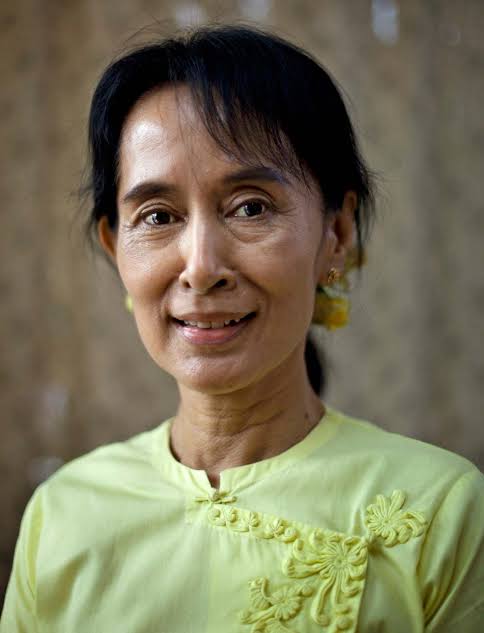
There are few figures in modern history whose story captures both the promise and the peril of human rights advocacy quite like Aung San Suu Kyi. For two decades, she was the world’s most recognisable symbol of nonviolent resistance to tyranny. Today, she sits in a Myanmar prison cell, convicted by the same generals she once defied, but she is remembered by much of the international human rights community not as a martyr, but as a cautionary tale.

Her story is one every human rights defender, and every government watching its own leaders closely, should sit with.
The Making of an Icon
Aung San Suu Kyi’s moral authority was forged in the years she spent opposing Myanmar’s military junta. Drawing on Gandhian principles of nonviolence and Buddhist philosophy, she helped lead the 8888 Uprising and co-founded the National League for Democracy. She spent roughly 15 of the following 21 years under house arrest, repeatedly refusing exile to remain with the people she represented.
Her writings, including the essay collection Freedom from Fear, framed her activism in the language of universal human rights, and the world rewarded her accordingly: the 1991 Nobel Peace Prize, honorary citizenships, and Amnesty International’s own Ambassador of Conscience award, bestowed on her in 2009 while she was still confined to house arrest.
For a generation of activists, she was proof that principle could outlast power.
Power, and the Unravelling
Everything changed after 2015, when Suu Kyi’s party swept to a landslide election victory and she assumed the role of State Counsellor, Myanmar’s de facto civilian leader. The moral critic became a political actor, operating inside a constitutional system the military had deliberately engineered to retain control, the armed forces held 25 percent of parliamentary seats and kept command of defence and security ministries regardless of who won at the ballot box.
It was in this compromised position that the defining failure of her career unfolded. Between 2016 and 2017, Myanmar’s military launched a brutal campaign against the Rohingya, a Muslim minority in Rakhine State. Thousands were killed. More than 700,000 fled into Bangladesh in what United Nations investigators would later describe as ethnic cleansing carried out with genocidal intent.
Suu Kyi did not condemn it. Instead, she minimised the reports, dismissed allegations as disinformation, and downplayed the mounting international alarm. In December 2019, she went further still, travelling personally to the International Court of Justice in The Hague to defend her country against genocide charges, describing the military’s campaign as a “clearance operation” against internal insurgents.
At home, her government pursued journalists who tried to expose the truth. Reuters reporters Wa Lone and Kyaw Soe Oo, who had uncovered evidence of a military mass grave, were prosecuted under colonial-era secrecy legislation, the same category of law once used against Suu Kyi herself. Activists and student dissenters continued to face charges for peaceful speech throughout her time in office.
Amnesty International Withdraws Its Highest Honour
The reckoning came in November 2018. Amnesty International withdrew its most prestigious human rights prize from Aung San Suu Kyi, accusing the Myanmar leader of perpetuating human rights abuses by failing to speak out about violence against the Rohingya Muslim minority. It was a startling rebuke from the very organisation that had championed her cause during her years of imprisonment.
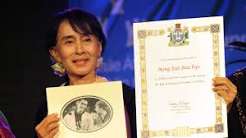
Amnesty’s Secretary General, Kumi Naidoo, wrote to Suu Kyi in November 2018 informing her that the organisation was revoking the 2009 award. In his letter, Naidoo expressed grievous disappointment that she had not used her political and moral authority to safeguard human rights, justice, or equality in Myanmar, pointing specifically to her indifference toward the military’s atrocities and a growing intolerance for free expression under her government.
The Ambassador of Conscience award had been the latest blow to her international standing since Myanmar’s military drove roughly 720,000 Rohingya out of the country. She had already been stripped of an honorary Canadian citizenship weeks earlier over the same failure to speak up for the persecuted minority.
Naidoo’s letter was blunt about what had been lost. Amnesty said it was profoundly dismayed that she no longer represented a symbol of hope, courage, and the undying defence of human rights, and that it could not justify her continued status as a recipient of the award. It was, in effect, an institution publicly admitting it had misjudged how durable one woman’s commitment to human rights truly was once she held power herself.
The Coup, and a Bitter Irony
In February 2021, the military she had spent a career resisting turned on her once more. In a coup, the Tatmadaw detained Suu Kyi and seized total power, subjecting her to closed-door trials on charges ranging from corruption to breaches of official secrets law. She was handed lengthy prison sentences and remains imprisoned today.
There is a bitter irony in this: the woman who defended the military’s actions against the Rohingya at the world’s highest court was, within a year, back in the position she had occupied for most of her adult life, a political prisoner of the same generals. But this time, the global human rights community views her through a far more critical lens.
The Lessons for Human Rights Work
Suu Kyi’s trajectory offers uncomfortable lessons that human rights institutions, advocates, and the public would do well to absorb.
First, opposition to tyranny is not the same as commitment to universal rights. Suu Kyi’s activism was rooted in resistance to military rule on behalf of Myanmar’s Bamar Buddhist majority, not in a universalist human rights framework extending to all ethnic and religious minorities. Her political worldview aligned with a Burmese nationalism that regarded the Rohingya as outsiders rather than citizens. The world conflated her fight against dictatorship with a broader moral commitment that, for the Rohingya, never existed.
Second, power reveals what struggle can conceal. Some analysts argue Suu Kyi calculated that confronting the military directly over the Rohingya would have triggered an immediate coup, and that her silence was a strategic concession to preserve a fragile civilian government operating under a military-engineered constitution. Whether read as cowardice or realpolitik, the outcome for the Rohingya was the same.
Third, human rights protection cannot rest on individual icons. Perhaps the most durable lesson is institutional rather than personal: durable human rights protections come from strong institutions, laws, and accountability mechanisms; not from faith in the moral character of any single leader, however heroic their past. International observers who equated Suu Kyi’s suffering under the junta with a lifelong commitment to human rights for all overlooked the nationalist foundations of her movement until it was too late for the Rohingya.
Amnesty International’s decision to strip her of its highest honour was more than symbolic. It was an acknowledgment that human rights institutions must be willing to hold even their own icons to account, and a reminder that the credibility of the human rights movement depends on that willingness, not on the comfort of old certainties.