

The Week Nigeria Stopped Counting: August 2-8 and the Normalization of Violence

From an Afrobeat icon’s death to bullets fired on pro-democracy marchers, a promised Boko Haram inquiry that never surfaced, a president arrested for calling a protest, and a single 2020 week that left dozens dead across five states, the first week of August is where Nigeria’s culture of dissent and its culture of impunity have repeatedly collided
Not every entry in Nigeria’s human rights calendar is a single, named atrocity. Some weeks are remembered instead for what they reveal about a pattern , a government promise left unfulfilled, a protest met with gunfire, or simply a seven-day stretch in which violence across several states barely registered as news. The first week of August, spanning five decades of the country’s history, is one of those weeks, and it is also, unusually, the week that claimed the life of the man who spent three decades singing about all of it.
1991: Fury of Students
On August 2, 1991, students at the University of Ibadan pelted the motorcade of military president General Ibrahim Babangida with stones and sticks during his official visit to the campus. The violent protest reflected intense national anger over the regime’s harsh economic policies, rising inflation, and shrinking civic freedoms.
Fearing severe repercussions from the military government, university authorities cracked down on campus leadership. At least one student faced immediate expulsion, while roughly 30 others received suspensions for participating in the stoning of the convoy.
1994: Bullets Answer a Pro-Democracy March
On August 3, 1994, police in Lagos opened fire on demonstrators and killed three protesters, part of a wave of pro-democracy agitation that swept the city that year. The killings came amid the broader crisis touched off by General Ibrahim Babangida’s annulment of the June 12, 1993 presidential election, a crisis that General Sani Abacha’s subsequent seizure of power did nothing to resolve. Human Rights Watch, documenting the period in a report pointedly titled “The Dawn of a New Dark Age,” recorded the Lagos shootings alongside other protest killings that year, including an attack on demonstrators at Obafemi Awolowo University by police under the direction of the state’s military administrator, and later, in Abia State, a peaceful protest that also ended in an unknown number of deaths.
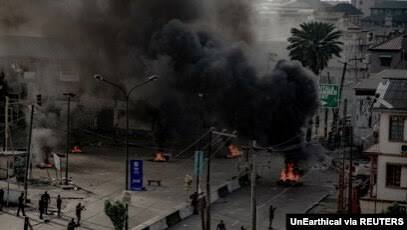
Nigerian authorities, the same report noted, rarely followed such killings with independent investigations or prosecutions, even as thuggery and street violence around the protests were sometimes used to justify the level of force deployed against demonstrators.
1997: The Silencing of Nigeria’s Loudest Voice
On August 2, 1997, Fela Anikulapo-Kuti, the Afrobeat pioneer and one of the most relentless critics of Nigeria’s military governments, died in Lagos at 58 from complications of AIDS. For nearly three decades, Fela had turned his music and his Kalakuta Republic compound into a running indictment of successive regimes, most pointedly the governments of Generals Olusegun Obasanjo and Muhammadu Buhari. That confrontation carried a heavy personal cost: in 1977, soldiers stormed Kalakuta Republic in a raid that left the compound destroyed and Fela’s mother, the veteran activist Funmilayo Ransome-Kuti, fatally injured. In 1984, he was convicted on a currency-smuggling charge and imprisoned — a conviction Amnesty International declared politically motivated, and from which he was eventually released.
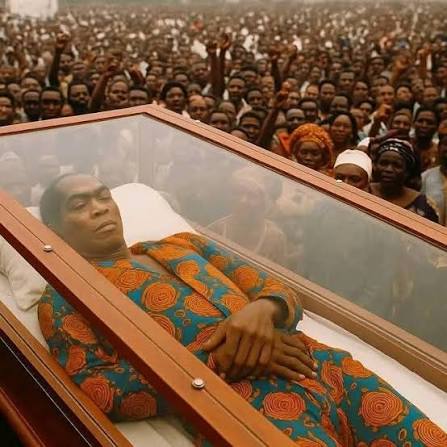
An estimated one million people lined the streets of Lagos for his funeral procession, a scale of public mourning rarely seen in the country’s history, testament to how deeply his decades of defiance against state violence and corruption had resonated far beyond music.
2009: A Promised Investigation That Never Came
On August 4, 2009 — a week after the Boko Haram uprising had left more than 700 people dead and the sect’s founder, Mohammed Yusuf, extrajudicially killed in police custody — President Umaru Musa Yar’Adua publicly pledged a full investigation into the uprising, including the circumstances surrounding Yusuf’s death. It was, on its face, a rare official acknowledgment that something beyond ordinary law enforcement had taken place in Maiduguri that July.
No such investigation was ever made public. By the end of that year, according to the U.S. State Department’s own human rights reporting, no findings had been released — an outcome that would become a familiar coda to nearly every major security-force killing in the years that followed: a promise of accountability, announced under public pressure, and then quietly left to lapse.
2019: Activist Arrested Two Days Before His Planned Protest
On August 3, 2019, operatives of the Department of State Services arrived at the Lagos home of Omoyele Sowore, the Sahara Reporters publisher and a former presidential candidate, and took him into custody, two days ahead of the nationwide #RevolutionNow demonstrations he had organized to demand better governance, an end to systemic corruption, and an end to extrajudicial killings. The DSS accused him of plotting to overthrow a democratically elected government; Nigeria’s police chief separately branded the planned protest an act of “treasonable felony.”
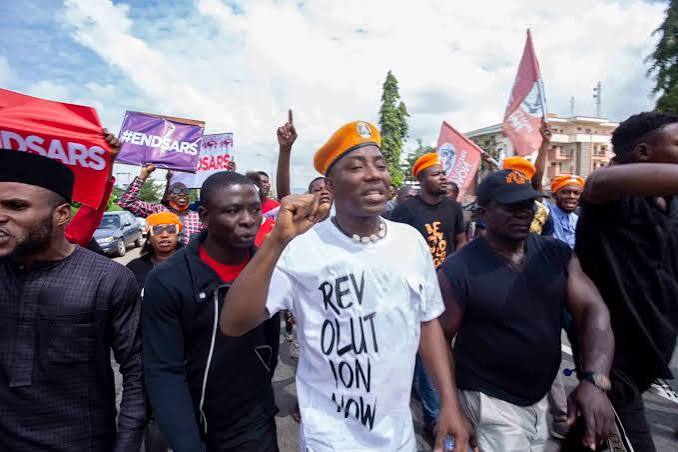
The warnings did not stop the demonstrations. On August 5, protesters gathered in Lagos, Abuja, Osogbo, and Calabar; in Lagos, police dispersed the crowd at the National Stadium with tear gas, and demonstrations were met with force in several states, resulting in dozens of arrests, including of at least one journalist covering the crackdown. The following day, the DSS asked a federal court to detain Sowore for ninety days under Nigeria’s Terrorism Act; the court granted forty-five, without hearing his defense. Amnesty International and domestic rights groups condemned the sequence of events as a direct assault on the constitutionally guaranteed freedoms of assembly and expression.
2020: One Ordinary Week, Tallied
If the earlier entries in this week’s history show the state answering dissent with force, silence, or both, the first week of August 2020 shows something different: how ordinary that violence had become by the second decade of the 2000s, spread thinly enough across the map that no single incident commanded national attention on its own.
According to the Council on Foreign Relations’ Nigeria Security Tracker, the week opened on August 2 with police killing three suspected kidnappers in Etche, Rivers State, cultists killing five people in Akpabuyo, Cross River State, and a Boko Haram suicide bomber killing herself and two others in Konduga, Borno State. On August 3, police shot and killed a protester in Isoko North, Delta State, while gunmen killed a journalist and one other person in Nasarawa Eggon, Nasarawa State — a press-freedom casualty that drew far less attention than it would have in a quieter week. Nigerian troops killed six suspected pirates in Southern Ijaw, Bayelsa State, on August 4.
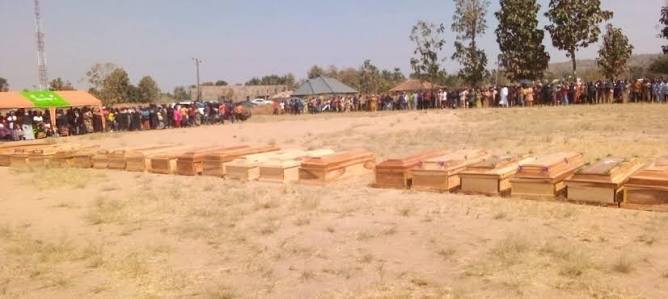
The week’s single deadliest incident came on August 5, when Fulani militia killed thirty-three people in Zangon Kataf, a Kaduna State community with a long, painful history of communal bloodshed dating back to the ethno-religious clashes of the 1990s. The same day, gunmen killed four people at a church in Yenagoa, Bayelsa State. By August 6, both police and army units in Katsina State reported killing ten suspected bandits apiece, in Batsari and Dutsinma respectively — a reminder that lethal force by security agencies against alleged criminal suspects, often without judicial process, had itself become a routine weekly entry in the country’s security ledger.
Taken individually, none of these incidents made international headlines. Taken together, they describe a single ordinary week in which more than seventy people across six states died from communal violence, banditry, terrorism, or the state’s own use of force — a toll that, in most other countries, would constitute a national emergency.
2021: Re-Arrest of Activist Omoyele Sowore & Court Challenges
Two years after his initial arrest during the 2019 #RevolutionNow campaign, human rights activist and journalist Omoyele Sowore was repeatedly intercepted, harassed, and briefly detained by security forces near the Federal High Court in Abuja between August 5 and 6, 2021.Civil society organizations flagged these repeated detentions as part of a ongoing strategy of judicial harassment aimed at suppressing freedom of assembly, mobility, and press freedoms.
2024: Nationwide #EndBadGovernance Crackdown & Mass Arrests
Following the kickoff of national protests against severe economic hardship and inflation on August 1, the week of August 2–8, 2024, saw heavy state crackdowns across Nigeria, including Abuja, Kano, Kaduna, Katsina, and Jigawa.
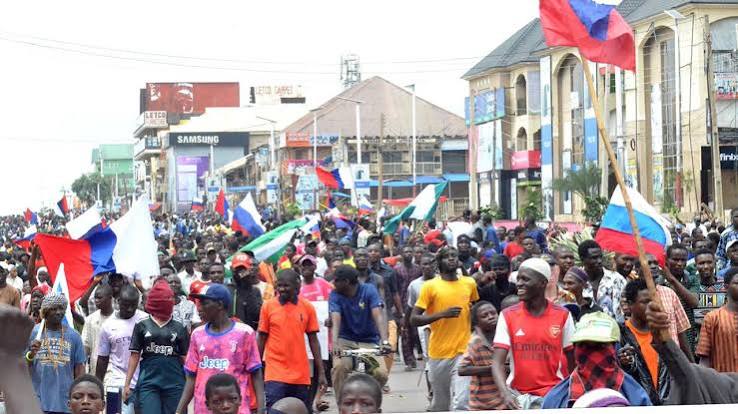
August 2–3: Security agencies deployed tear gas and live ammunition against crowds, resulting in multiple civilian deaths and injuries. In Katsina State, state security services arrested protest organizers, while local governments imposed 24-hour curfews to curtail movement.
August 5–8: More than 1,000 demonstrators, journalists, and bystanders were arrested nationwide. On August 8, security forces raided the Nigeria Labour Congress (NLC) headquarters in Abuja, seizing documents in connection with the demonstrations. Amnesty International and Human Rights Watch condemned the security forces’ excessive use of lethal force, noting that at least 24 people, including minors, were killed during the 10-day protests. Over 100 detainees (among them minors) were later charged with high treason under severe detention conditions before charges against the children were eventually dropped following public outcry.
A Week Without a Single Headline
What connects 1994, 1997, 2009, 2019, 2020,2021 and 2024 is not a shared atrocity but a shared absence: of prosecutions after the Lagos shootings, of a published report after Yar’Adua’s promise, of due process before Sowore’s detention, and of any sustained national reckoning with the fact that dozens of Nigerians can die in a single week to violence from at least four distinct sources, police, soldiers, militia, and terrorists, without the country pausing to ask why. Even Fela’s death, decades removed from politics, sits inside that same story: a reminder that Nigeria’s most visible critic of state violence spent his life documenting exactly the pattern this week keeps repeating. For NOHR and the wider human rights community, this week’s history is less a list of dates to remember than a diagnosis: impunity in Nigeria has rarely required a single dramatic event. Often, it has simply required silence, repeated often enough to become routine.